
 American Food History
The History of Buffalo Wings: A Late Night Snack That Became...
Published On 17-09-2026
Published by Restaurant Listings Editorial Team
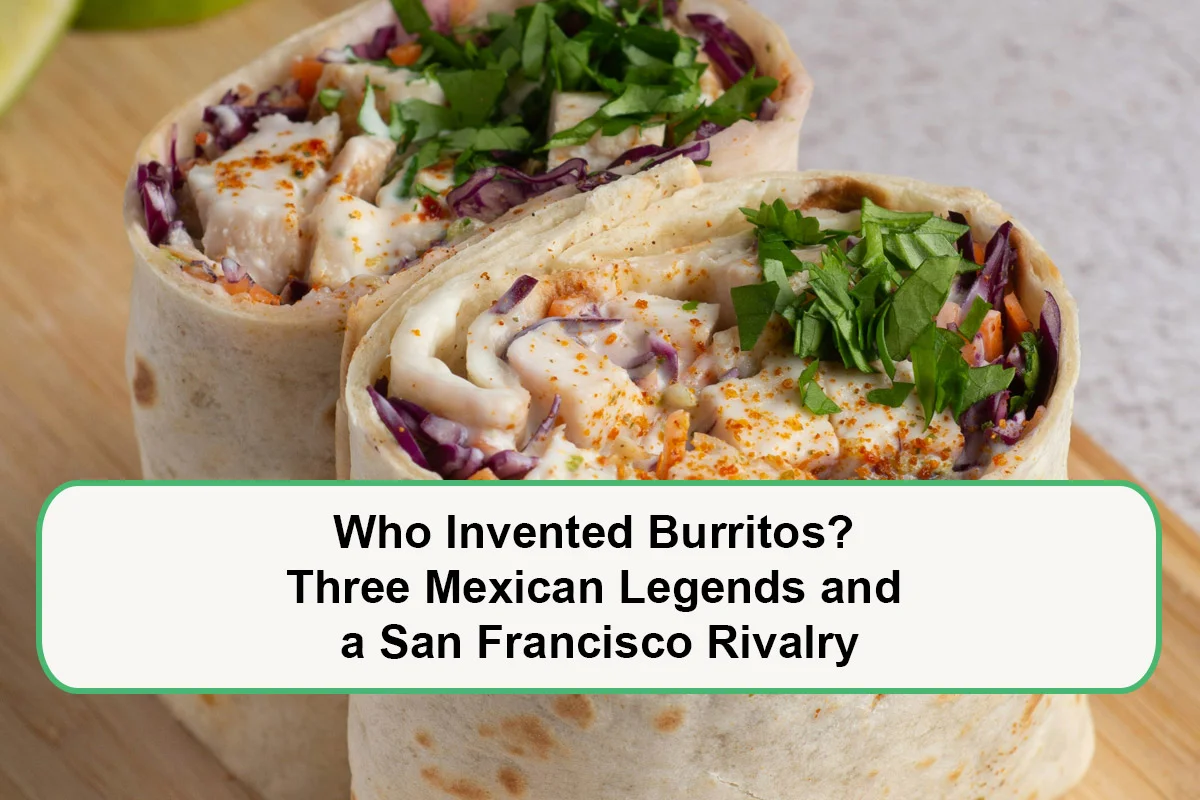
The burrito has one of the more genuinely confusing origin stories in Mexican food history, mainly because there isn't just one competing legend, there are at least three, and none of them can be fully verified. Layer on top of that a second, much better documented rivalry in San Francisco that gave rise to the oversized burrito most Americans actually picture today, and you end up with a dish whose history is really two separate mysteries stacked on top of each other.
Before getting into the competing legends, it's worth starting with what's genuinely on the historical record. The word "burrito" first appeared in print in 1895, in the Diccionario de Mejicanismos, a Mexican Spanish dictionary written by Cuban author Félix Ramos y Duarte. The entry described a rolled tortilla filled with meat or other ingredients, noting that the same basic dish was called "cocito" in Yucatán and "taco" in Cuernavaca and Mexico City. Even this earliest documented reference leaves real ambiguity, since it's genuinely unclear whether Ramos y Duarte was describing what we'd now call a burrito or simply an early regional word for a taco.
Most food historians agree the dish itself originated in northern Mexico, particularly the states of Chihuahua and Sonora, regions where flour tortillas, rather than corn, have historically been the norm. In that context, workers commonly rolled meat, beans, and other fillings into large flour tortillas to create a portable, filling meal that stayed warm and traveled well, exactly the kind of practical, working class food that rarely gets formally documented until decades after it's already common.
The most frequently repeated origin story credits a street food vendor named Juan Méndez, who reportedly sold food in Ciudad Juárez during the Mexican Revolution, roughly between 1910 and 1920. According to the legend, Méndez transported his food around the city on a small donkey and wrapped it in large homemade flour tortillas to keep it warm during transport. As "the food of the little donkey" grew popular, the name "burrito," meaning literally "little donkey" in Spanish, was eventually attached to the dish itself rather than just the animal carrying it.
Most careful historical sources, including Britannica, describe this account as almost certainly apocryphal, meaning widely repeated but lacking solid supporting documentation. It's a satisfying story precisely because it directly explains the name, which is probably part of why it's the version most commonly repeated, even without strong evidence behind it.
A second, considerably less flattering theory places the burrito's invention in 1940s Ciudad Juárez as well, but with a different vendor and a different explanation for the name. According to this account, an unnamed street vendor sold tortilla wrapped food specifically to schoolchildren at a nearby institution, affectionately, or perhaps not so affectionately, nicknaming the kids "burritos," using the word as regional slang for someone slow or dimwitted. Over time, that nickname for the children reportedly transferred to the food itself.
The third theory skips personal legend entirely and offers a more mundane, utilitarian explanation. According to this account, the burrito developed in Sonora, a wheat growing region in northwestern Mexico, purely because a rolled flour tortilla filled with food was an exceptionally practical, easy to carry meal for travelers and laborers. Under this theory, the "little donkey" name comes not from a specific person's actual donkey, but from the food's resemblance to the compact bedrolls and packs commonly strapped to donkeys used as pack animals throughout the region.
Food writer Gustavo Arellano, author of "Taco USA: How Mexican Food Conquered America," has pointed out that the underlying concept driving all three legends isn't especially complicated. A flatbread wrapped around fillings as a way to preserve food or carry a meal to work is, in his words, not exactly rocket science, which may be exactly why the specific originating moment is so hard to pin down: it's the kind of practical idea that could plausibly have emerged independently in more than one place around the same general period.
| Legend | Location and Era | Explanation for the Name |
|---|---|---|
| Juan Méndez | Ciudad Juárez, 1910s (Mexican Revolution) | Named after his donkey, used to transport and keep food warm |
| Nicknamed schoolchildren | Ciudad Juárez, 1940s | Vendor's nickname for the children transferred to the food |
| Sonora utility theory | Sonora, 19th century | Resemblance to bedrolls and packs carried by donkeys |
While the burrito's Mexican origin remains genuinely murky, the specific, oversized, foil wrapped burrito most Americans think of today has a much more recent and considerably better documented history, and it comes with its own real rivalry. Two taquerias in San Francisco's Mission District, Taqueria La Cumbre and El Faro, both independently claim to have invented what's now called the Mission style burrito.
According to owner Febronio Ontiveros, El Faro sold its first oversized burrito on September 26, 1961, when a group of hungry local firefighters came in looking for sandwiches. Ontiveros reportedly served them a large burrito instead, combining two six inch flour tortillas into one substantial wrap filled with meat, rice, and salsa, and the dish became a permanent menu fixture from there. Raul and Micaela Duran, owners of La Cumbre, offer a competing account, dating their version of the creation to September 29, 1969, nearly eight years after El Faro's claimed date.
Unlike the Mexican legends, this rivalry comes with real institutional backing on at least one side. El Faro was officially recognized as a San Francisco Legacy Business specifically for its role as creator of the Mission burrito, and food writer Gustavo Arellano has stated he personally favors El Faro's account over La Cumbre's. Even so, some food historians note the format may have even earlier, uncredited roots among California Central Valley farmworkers, who reportedly ate large, hearty tortilla wrapped meals in the fields throughout the 1960s, meaning even the well documented San Francisco rivalry may not represent the true beginning either.
The Mission burrito wasn't just a bigger version of an existing dish, it introduced genuine structural changes that came to define the American burrito more broadly:
This Mission style approach went on to directly influence American fast casual chains, including major national burrito concepts, extending its reach well beyond the Bay Area neighborhood where it was created.
San Francisco's Mission burrito is far from the only regional American claim to burrito innovation. San Diego developed its own distinct format, the California burrito, typically incorporating french fries directly inside the wrap alongside carne asada, a genuinely polarizing addition that some diners consider a defining regional innovation and others consider close to sacrilege. Los Angeles and parts of Texas maintain their own regional burrito traditions as well, each with local advocates insisting their version represents the definitive style. As food writer Gustavo Arellano has noted, at nearly every point in the burrito's evolution, there's been a Mexican or Mexican American cook behind the innovation, whether the specific credited individual or restaurant can be fully verified or not.
A genuinely unresolved origin story still offers useful, practical context for diners:
For more on other iconic dishes where the "true inventor" question is just as contested, see our guides to who invented tacos and who invented hamburgers. And for the full backstory on the taco specifically, including its own disputed word origin, see where tacos originated.
A few trends are likely to keep shaping the burrito's next chapter in the U.S.:
Reviewed and verified by the Restaurant Listings Editorial Team for accuracy and relevance. Our content is researched using official restaurant sources, public records, government agencies, and recognized food safety and hospitality industry resources.
Last reviewed: September 2026
American Food History
 American Food History
 American Food History