
 Food History & Origins
Chicago Tavern-Style Pizza: Neighborhood Traditions and Wher...
Published On 15-10-2026
Published by Restaurant Listings Editorial Team
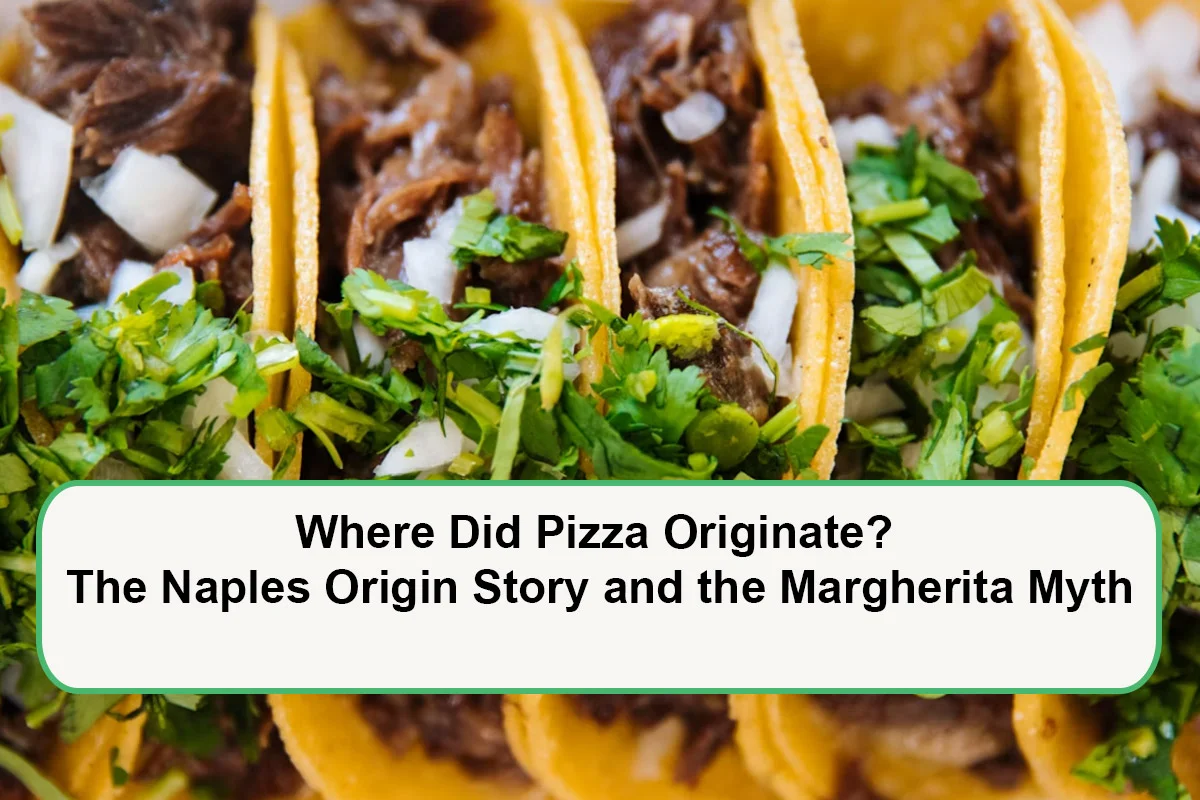
Tacos feel like they should be an ancient, timeless part of Mexican cuisine, the kind of dish that goes back centuries without much change. The corn tortilla itself really does stretch back thousands of years. But the taco specifically, as both a word and a food concept, has a genuinely surprising origin story that traces back not to an ancient kitchen, but to 18th and 19th century Mexican silver mines, and to explosives.
Before there was a taco, there was the tortilla, and its roots run genuinely deep. Corn cultivation in Mexico is generally traced back roughly 9,000 years, and archaeological evidence suggests that by around 1500 BCE, corn was already being ground into a flour-like consistency and formed into flatbreads, likely the earliest form of the tortilla. These early flatbreads served a practical function beyond simply being food: they were used as an edible vessel to scoop up other dishes, protecting hands from the heat of hot stones or cooking vessels.
Long before Spanish colonization, communities across what's now Mexico were already using tortillas to wrap and hold other foods, including fish and organ meats, a practice that closely resembles the basic taco concept, even though the word "taco" itself didn't exist yet.
According to Jeffrey Pilcher, a historian who has spent decades researching Mexican culinary history, the term "taco" most likely originated in Mexican silver mines during the 18th century, where it originally referred to something that had nothing to do with food at all: small explosive charges used to excavate ore. Miners would wrap gunpowder in paper, forming a small, cylindrical charge that could be inserted into holes carved into the rock face before detonation. That paper wrapped explosive charge was called a "taco."
The food connection came soon after, and it's a genuinely clever piece of linguistic history. Miners began referring to their own lunches, tortillas wrapped around potatoes or other simple fillings, as "tacos" as well, because the wrapped food closely resembled the shape of the wrapped explosive charges they used every day on the job. As Pilcher put it, a taquito with a good hot sauce genuinely does resemble a small stick of dynamite. The earliest documented references to tacos in any dictionary or archive come from the end of the 19th century, and one of the very first types recorded is specifically called "tacos de minero," meaning miner's tacos.
It's worth noting there's a competing theory about the word's roots as well: some sources trace "taco" to the Nahuatl word "tlahco," meaning "half" or "in the middle," a reference to the way the tortilla is folded around its filling. Both explanations may hold some truth simultaneously, since language origins are rarely perfectly clean or singular, but the silver mine connection has the strongest documented historical backing.
Here's the detail that tends to catch people off guard: despite feeling like a food with ancient, unbroken tradition behind it, the taco as a named, recognizable dish is not actually old at all. Pilcher has been direct about this point, noting that the taco is not some age old cultural expression reaching back to time immemorial. The tortilla itself is ancient. The taco, as a specific word and food concept built around that miner's lunch tradition, is genuinely a product of the 18th and 19th centuries, making it, in relative historical terms, a fairly recent invention.
Tacos might have remained a niche mining term if not for the industrialization and social changes that reshaped Mexico in the following decades. As Mexican industries modernized and increasing numbers of workers, including a growing population of female migrants, moved into Mexico City looking for work, tacos moved with them. The dish became firmly established as working class food, served in the bustling barrios of Mexico City, affordable, portable, and filling enough to sustain long working days.
From there, taquerías (dedicated taco stands and small restaurants) began appearing throughout Mexican cities, becoming genuine social hubs as much as places to eat, a role many taquerías continue to play in communities today.
As tacos spread across Mexico, they diversified dramatically, absorbing regional ingredients and, in at least one especially notable case, direct immigrant influence. Tacos al pastor, one of the most beloved and widely recognized taco styles today, developed from spit roasted meat techniques brought to Mexico by Lebanese immigrants in the early 20th century, a direct adaptation of shawarma style cooking reimagined with Mexican spices, pineapple, and corn tortillas. This is a genuinely important detail: one of the tacos most people consider quintessentially, traditionally Mexican actually reflects a specific, relatively recent cross cultural exchange, not an unbroken indigenous tradition.
Other regional taco styles, like carnitas, barbacoa, and adobada, developed their own distinct identities as the format spread across Mexico's varied regions, each shaped by local proteins, cooking methods, and available ingredients.
Mexican migration into the United States, particularly into the Southwest, carried taco traditions across the border throughout the 20th century. But the taco's most significant transformation on American soil came through a specific commercial moment: in 1962, Glen Bell launched Taco Bell, introducing a mass market, standardized version of the taco to a broad American audience for the first time. Bell's version notably relied on a hard shell tortilla, a distinctly American adaptation rarely used in traditional Mexican taco preparations, which favor soft corn tortillas.
This divergence helps explain a genuine, ongoing point of confusion for many American diners: the crunchy, hard shell taco widely associated with "Mexican food" in the U.S. is largely an American commercial invention, while traditional Mexican tacos, then and now, are built on soft corn tortillas.
Given how far the format has spread and diversified, a few markers help distinguish tacos made with real technique and tradition from a shortcut, mass market version:
A few trends are likely to keep shaping how tacos continue evolving both in Mexico and internationally:
Reviewed and verified by the Restaurant Listings Editorial Team for accuracy and relevance. Our content is researched using official restaurant sources, public records, government agencies, and recognized food safety and hospitality industry resources.
Last reviewed: August 2026
Food History & Origins
 Food History & Origins
 Food History & Origins