
 Food Knowledge
Gluten-Free Pizza at Restaurants: Dedicated Ovens vs Shared...
Published On 15-10-2026
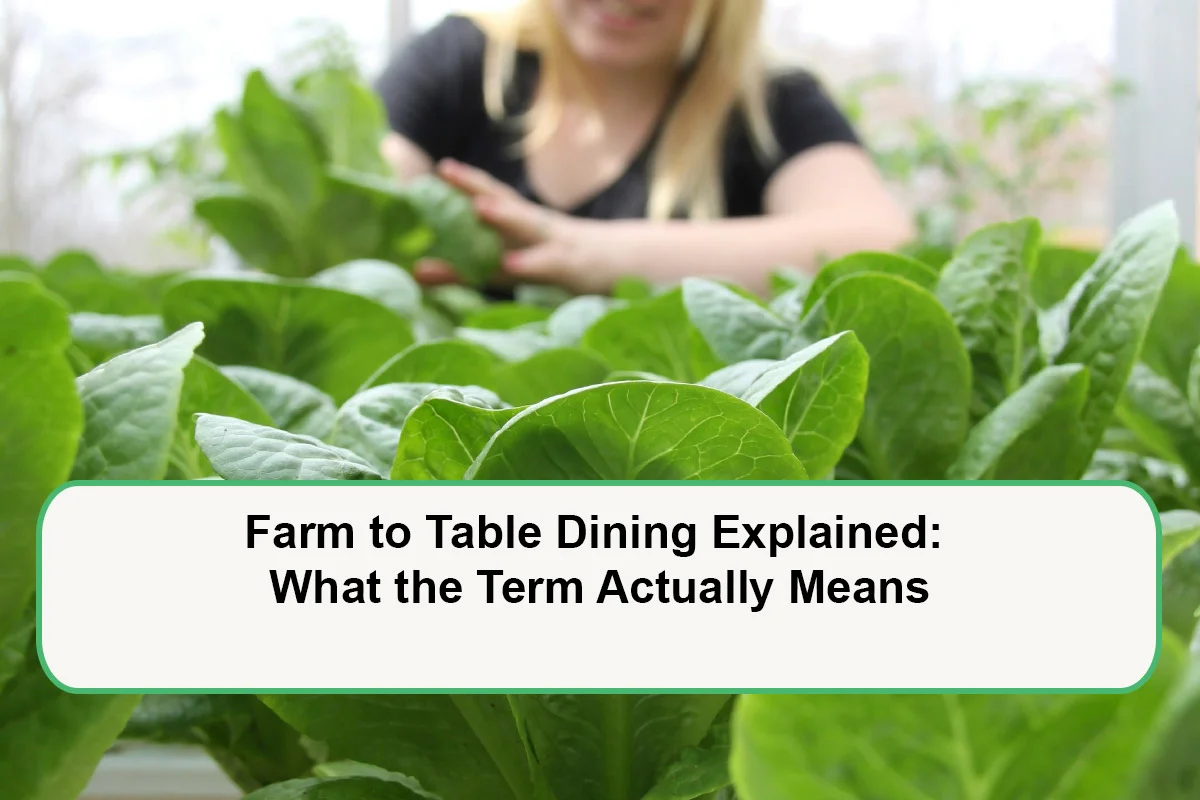
Farm to table shows up on menus everywhere now, from upscale tasting rooms to fast casual salad chains, but the phrase carries no legal definition and no certifying body behind it. That gap between what farm to table is supposed to mean and what a restaurant can print on a menu without much oversight is worth understanding before you pay a premium for it.
At its simplest, farm to table describes food that moves directly from a farm or ranch to a restaurant kitchen with as few steps as possible in between, cutting out the wholesalers and large distributors that typically sit between a grower and a commercial kitchen. In practice, the idea rests on a few consistent principles, direct sourcing relationships where the restaurant knows exactly which farm an ingredient came from, a short supply chain that minimizes the distance and time food travels before it is cooked, and a menu that shifts with the seasons rather than staying fixed year round regardless of what is actually being harvested nearby.
Unlike a label such as USDA Organic, which carries a legal definition and requires certification to use, farm to table has no equivalent oversight. Any restaurant can print the phrase on a menu without a third party verifying that it is true, which means the term functions more as a description a business applies to itself than a guarantee backed by regulation. That is not automatically a red flag, plenty of small restaurants genuinely source most of their menu from nearby farms without bothering to get any formal certification, but it does mean the phrase alone tells you less than it appears to.
The modern farm to table movement traces back to a broader push toward local, seasonal, ingredient driven cooking that gained momentum in American fine dining starting in the 1970s, closely associated with chefs who built menus around what nearby farms were actually growing rather than importing ingredients from anywhere in the world year round. Over the following decades, the philosophy spread well beyond fine dining. Sweetgreen, founded in Washington, D.C. in 2007, built an entire fast casual salad chain around the concept, working with hundreds of farms across the regions where it operates to keep the distance between farm and bowl as short as possible, proof that the idea could scale beyond a single expensive tasting menu restaurant.
Since the term is not regulated, a little curiosity goes a long way. A restaurant that is genuinely sourcing directly from farms will usually be able to name the specific farm, ranch, or fishery an ingredient came from, sometimes right on the menu itself, rather than giving a vague answer about local sourcing when asked. A seasonal menu that actually changes multiple times a year, rather than staying identical every month regardless of what is in season, is another strong signal. It also helps to ask whether the commitment extends beyond produce. A restaurant that sources vegetables locally but still gets its meat, dairy, and seafood from the same large national distributors as everywhere else is only partially living up to the phrase, even if the menu leans heavily on that produce commitment for marketing.
| Signal | Likely Genuine | Likely Marketing Only |
|---|---|---|
| Names specific farms on the menu | Yes, often by name | Rarely, tends to stay vague |
| Menu changes with the seasons | Changes several times a year | Stays largely the same year round |
| Sourcing extends beyond produce | Proteins and dairy sourced locally too | Often only produce, proteins still wholesale |
| Staff can answer sourcing questions | Specific, confident answers | Vague or rehearsed marketing language |
Consumer research backs up why so many restaurants lean on the phrase. A large majority of diners say they will pay more at restaurants that prioritize sustainability, and local sourcing has repeatedly ranked among the top trends in the National Restaurant Association's annual industry forecasts. For restaurants, that willingness to pay a premium is a major part of the business case for building real relationships with nearby farms rather than treating the phrase as pure decoration.
Genuine farm to table sourcing is harder to run than it sounds. Small farms typically charge more than large distributors, since they lack the scale to compete on price, which pushes up a restaurant's food costs. A menu that changes seasonally requires constant creative work from the kitchen rather than settling on a fixed menu once and repeating it indefinitely. Maintaining a consistent supply from small scale producers is also less predictable than ordering from a national distributor with guaranteed inventory, and restaurants often have to educate customers on why a seasonal, locally sourced dish costs more than a similar item elsewhere.
Farm to table often gets used loosely alongside related ideas like locally sourced or organic, but they are not interchangeable. Organic refers to a specific, legally regulated growing standard that has nothing to do with distance or supply chain length. Locally sourced generally just means food came from somewhere nearby, without necessarily implying a direct relationship with the grower. Farm to table is meant to combine both a short supply chain and a direct sourcing relationship, though because no one enforces the phrase, restaurants sometimes use it more loosely than its original meaning intended. Our guide to organic versus locally sourced food breaks down that distinction in more detail.
The phrase gets applied very differently depending on the type of restaurant using it. At a high end, tasting menu driven restaurant, farm to table often means a chef has built personal relationships with a small handful of specific farms and designs the entire menu around whatever those farms are harvesting that week, sometimes changing dishes daily rather than seasonally. At a fast casual chain, the same phrase usually describes a broader network of regional farm partnerships built for consistency and scale rather than a tight, single farm relationship, since a chain serving thousands of meals a day cannot realistically depend on one small farm the way a twenty seat restaurant can. Neither approach is more legitimate than the other, but they represent genuinely different versions of what farm to table looks like in practice, and it helps to know which version you are actually getting.
If a restaurant's menu leans heavily on the farm to table label and you want to know whether it holds up, a few direct questions tend to reveal a lot quickly. Asking which specific farm a featured ingredient came from is the simplest test, since a restaurant with a real relationship will usually answer immediately and specifically. Asking how often the menu changes gives you a sense of whether the kitchen is actually cooking around the seasons or just describing a fixed menu with seasonal language. And asking whether that sourcing extends to proteins and dairy, not just produce, often reveals whether the commitment is comprehensive or mostly limited to a few vegetable forward dishes used to support the marketing on the rest of the menu.
Even restaurants that never explicitly market themselves as farm to table have absorbed pieces of the philosophy over the past two decades. Seasonal specials, menus that rotate a few times a year instead of staying static indefinitely, and chefs printing a supplier's name next to a dish are all practices that were fairly rare outside high end dining before the farm to table movement pushed them into the mainstream. In that sense, the phrase's biggest impact may not be the restaurants that use the exact words on their menu, but the broader shift it created in how American diners now expect to know at least something about where their food came from, a level of curiosity that barely existed in casual dining a generation ago.
Farm to table can absolutely be real, and when it is, it usually means fresher ingredients, a menu tied to what is actually in season, and money that stays within the local economy rather than flowing to a distant distributor. It just pays to ask a question or two rather than taking the phrase at face value. For more on how ingredient quality and sourcing affect what ends up on your plate, see our guides on how restaurants source ingredients, fresh versus frozen ingredients, grass fed versus grain fed beef, and wild caught versus farm raised seafood.
Reviewed and verified by the Restaurant Listings Editorial Team for accuracy and relevance. Our content is researched using official restaurant sources, public records, government agencies, and recognized food safety and hospitality industry resources.
Last reviewed: September 2026
