
 Dining Etiquette
What Is Corkage, and How Does BYOB Etiquette Work?
Published On 18-09-2026
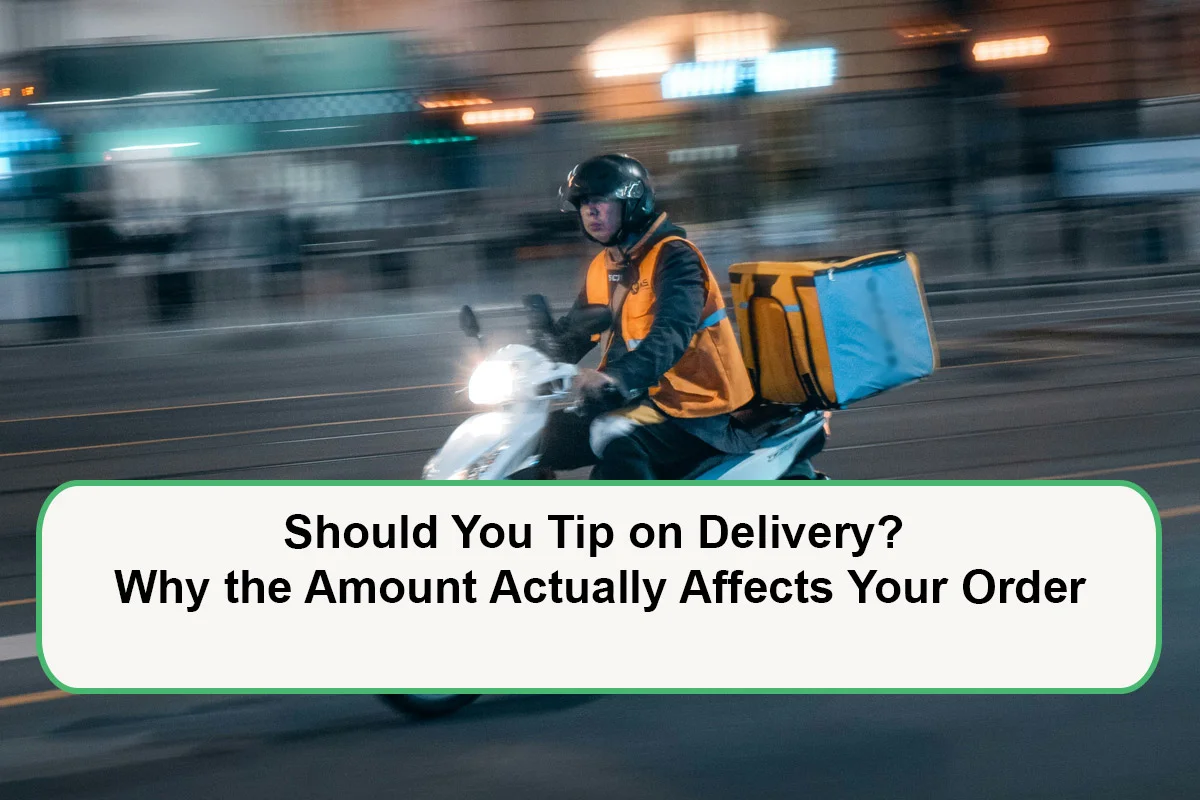
Delivery tipping isn't the same discretionary gray area as tipping on takeout, and understanding why changes how you should actually think about it. A delivery driver is dedicating real time and their own vehicle exclusively to your order, and on major apps like DoorDash and Uber Eats, your tip is visible to drivers before they even accept the delivery. That single mechanical detail is the reason a low tip doesn't just shortchange a driver, it can genuinely slow your food down. For how this compares to standard restaurant tipping, see our guide to how much you should tip.
The customary tip for food delivery in 2026 is 15 to 20 percent of the order subtotal, before fees and taxes, with a firm minimum of $3 to $5 regardless of how small the order is. On small orders, percentages break down fast: a $3 tip on a $30 order works out to 10 percent, but on a $10 order, 15 percent is only $1.50, well below any reasonable minimum. That's exactly why a flat floor matters as much as the percentage itself. Bankrate's 2025 Tipping Survey put the median food delivery tip at around 18 percent of the subtotal, a number that lines up closely, if slightly under, the standard for full-service restaurant dining.
This is the detail that separates delivery tipping from nearly every other tipping situation. Delivery drivers on major apps are independent contractors, not employees, and they aren't paid a traditional hourly wage. Their earnings come from a combination of base pay, typically just $2 to $10 per order depending on distance, time, and demand, plus whatever tip the customer adds. On DoorDash specifically, tips make up roughly 49 percent of total driver pay, at a 2026 median of $8.82 per delivery. Uber Eats tips make up a similar share of driver earnings, at a lower national median of around $5.00 per delivery.
Independent research backs up just how central tips are to actual take-home pay. A UC Berkeley Labor Center study analyzing over 30,000 delivery trips found that California delivery workers' median net earnings, after expenses and excluding tips, came out to just $5.93 an hour. With tips included, that number rose to $13.62 an hour. In plain terms: tips on delivery apps aren't supplementing driver income the way a restaurant tip might round out an already reasonable wage, they're functioning as the majority of that income in the first place.
One of the most common and consequential misunderstandings in app-based delivery is assuming that the delivery fee charged at checkout goes to the driver. It doesn't. Both DoorDash and Uber Eats have stated publicly that delivery fees and service fees are separate platform charges covering company operations, not gratuity, and none of that money reaches the person who actually picks up and delivers your food. The only payment that goes directly to your driver, beyond their modest base pay, is the tip you add separately.
Here's the part that surprises a lot of people: on platforms like DoorDash and Uber Eats, drivers can see the tip amount attached to an order before deciding whether to accept it. Experienced drivers, particularly in busy metro markets, routinely decline low-tip or no-tip orders in favor of better-paying ones, which means a low or absent tip doesn't just shortchange the driver on a delivery that happens anyway, it can mean your order gets passed over repeatedly and sits waiting for a driver willing to take it, arriving considerably later and colder as a result.
| Situation | Suggested Tip |
|---|---|
| Standard order, normal conditions | 15 to 20% of the subtotal, $3 to $5 minimum |
| Small order (under roughly $15) | At least $3 to $5 flat, since a percentage alone would be too low |
| Large or complex order | Closer to 20%, given the added handling involved |
| Bad weather, heavy traffic, or long distance | A 30 to 50% bump above your usual tip is considered customary |
The weather and distance adjustment is worth taking seriously. A driver navigating snow, heavy rain, or a delivery several miles out of the way is putting more time, fuel, and wear on their own vehicle into that specific order, conditions the platform's flat base pay generally wasn't calculated around.
Most major platforms allow some flexibility here. Uber Eats, for example, lets customers adjust a tip for up to an hour after delivery, useful if service genuinely exceeded expectations and you want to reflect that after the fact. It's worth knowing this window exists, though the safer default is still to tip appropriately at checkout, since a driver deciding whether to accept your order only sees what you've committed to at that point, not a hypothetical future adjustment.
Delivery and takeout are frequently treated as interchangeable, but they carry meaningfully different tipping expectations. Takeout involves picking up your own order, with no driver, no vehicle, and no dedicated travel time involved, which is why tipping on takeout remains genuinely optional and typically runs lower, often in the 10 to 15 percent range when tipped at all. Delivery, by contrast, involves a person dedicating real time and their own transportation specifically to your order, which is why it carries a firmer, higher expectation. For the full breakdown on the pickup side of this comparison, see our guide to tipping on takeout.
A few trends are likely to keep shaping delivery tipping going forward:
Reviewed and verified by the Restaurant Listings Editorial Team for accuracy and relevance. Our content is researched using official restaurant sources, public records, government agencies, and recognized food safety and hospitality industry resources.
Last reviewed: September 2026
Dining Etiquette
 Dining Etiquette
 Dining Etiquette