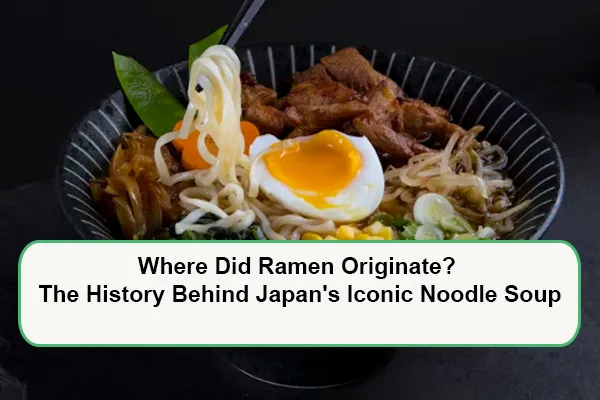
Ramen is one of the most recognizable symbols of Japanese food culture, but its origin story runs through China first. Understanding that history isn't a footnote or a technicality; it's central to understanding why ramen looks and tastes the way it does, and why the dish still carries a slightly different cultural weight in Japan than dishes with purely domestic origins, like soba or udon.
Ramen's direct ancestor is Chinese wheat noodle soup, generally referred to as lamian, a hand-pulled noodle dish with a long history in Chinese cuisine. Chinese immigrants and traders brought noodle-soup dishes to Japan, with meaningful documented influence emerging particularly from the late 19th century into the early 20th century, as Chinese communities established restaurants in Japanese port cities.
This is an important distinction: ramen is often described as a Chinese dish that Japan adapted and transformed rather than invented from scratch, similar in spirit to how other countries have taken Chinese noodle traditions and developed distinct regional interpretations. The word "ramen" itself is generally believed to derive from the Chinese term for pulled or stretched noodles, a linguistic trace of the dish's Chinese origin that survived even as the dish itself changed dramatically in Japan.
What separates ramen from its Chinese noodle-soup ancestors is a series of adaptations that happened specifically within Japan over the following century. A few of the most significant include:
- Broth diversification: Japanese ramen shops developed distinct regional broth styles shoyu (soy sauce), miso, shio (salt), and tonkotsu (pork bone) each associated with specific regions of Japan and representing genuinely different flavor profiles and preparation techniques.
- Post-WWII expansion: Ramen's popularity surged significantly in Japan during the post-World War II period, a time of food scarcity when wheat, often supplied through American aid programs, became more available, and ramen offered an affordable, filling meal that helped it spread rapidly across the country.
- Instant ramen's invention: The creation of instant ramen in the mid-20th century by Momofuku Ando, a Japanese-Taiwanese businessman, represented an entirely new innovation within the ramen category, one that dramatically expanded ramen's reach far beyond Japan and eventually around the world, even though it represents a very different product from fresh, shop-made ramen.
- Regional specialization: Distinct city and prefecture-specific ramen styles developed over decades, similar to how different Italian regions developed their own pasta traditions, resulting in dozens of recognized regional ramen styles across Japan today.
Understanding ramen's regional variety helps explain why one bowl can taste completely different from another, even at two well-regarded restaurants:
| Style |
Broth Base |
Regional Association |
| Shoyu |
Soy sauce-based, generally clear and brown |
Widely considered the original, most traditional style, associated with Tokyo |
| Miso |
Fermented soybean paste-based, hearty and rich |
Sapporo, Hokkaido |
| Shio |
Salt-based, light and clear |
Associated with some of the earliest ramen styles in Japan |
| Tonkotsu |
Pork bone-based, opaque and rich, long-simmered |
Kyushu region, particularly Fukuoka/Hakata |
Most American ramen shops offer some combination of these core styles, though many chefs also introduce their own creative variations that blend techniques or ingredients across regional traditions.
Ramen's presence in the U.S. developed in stages. Instant ramen entered the American market in the mid-20th century and became a widespread, inexpensive pantry staple long before most Americans had access to fresh, restaurant-style ramen. Real momentum for fresh, shop-made ramen in the U.S. built more significantly in the early-to-mid 2010s, as dedicated ramen restaurants, often opened by Japanese chefs or Japanese-trained American chefs, began expanding beyond a handful of coastal cities into a much broader national dining category.
This distinction matters for how people understand the dish today: many Americans' first exposure to "ramen" was the inexpensive instant version, which created a real gap in expectations once fresh, slow-simmered restaurant ramen became more widely available and diners realized how different a properly made bowl actually is.
Because ramen now ranges from instant packets to carefully crafted, hours-long broths, quality varies enormously. A few markers tend to separate restaurants treating ramen as a genuine craft from those serving a shortcut version:
- Long-simmered, house-made broth. Serious tonkotsu broth, for example, is often simmered for well over 12 hours to extract full flavor and body from the bones; shortcuts here are one of the most noticeable quality gaps.
- Proper noodle sourcing and texture. Ramen noodles have a distinct alkaline (kansui) component that affects both texture and flavor; noodles that are too soft, mushy, or generic in texture often signal lower-quality sourcing.
- Balanced tare (seasoning base). The concentrated seasoning base added to the broth, whether shoyu, miso, or shio, should be carefully balanced rather than simply salty; this is a key technical skill separating skilled ramen chefs from less experienced ones.
- Properly prepared toppings. Chashu pork, soft-boiled eggs, and other standard toppings should be prepared with real technique and care, not treated as an afterthought to the broth.
- Regional clarity. Strong ramen shops are often explicit about which regional Japanese style they're drawing from, rather than presenting a vague, undefined hybrid bowl.
These are useful markers for diners evaluating ramen quality, and they're the kind of detail that separates a surface-level restaurant listing from one that actually helps guests understand what they're ordering.
Serious ramen craftsmanship has developed strong followings across a wide range of American cities:
- New York City: A Lower East Side ramen restaurant is run by a chef recognized as one of only a small handful of individuals informally referred to as "Ramen Gods," reflecting decades of expertise built through his original restaurant in Japan.
- Washington, D.C.: An award-winning ramen and izakaya restaurant has built a strong local reputation for both its ramen program and its Japanese cocktail offerings.
- Austin, Texas: A ramen restaurant has earned back-to-back Michelin Bib Gourmand recognition, including creative plant-based ramen options alongside traditional styles, reflecting how far ramen craftsmanship has spread beyond coastal cities.
- "Ramen is a purely Japanese invention." Ramen's direct ancestor is Chinese wheat noodle soup; Japan adapted, transformed, and regionalized the dish over the following century rather than inventing it independently.
- "Instant ramen and restaurant ramen are basically the same thing." While related, they're genuinely different products, with fresh restaurant ramen involving significantly more elaborate broth preparation, noodle-making, and topping technique.
- "All ramen tastes roughly the same." Shoyu, miso, shio, and tonkotsu styles differ substantially in broth base, richness, and regional technique.
- "Ramen has always been popular in Japan." Ramen's major surge in popularity within Japan is largely tied to the post-World War II period, making its dominant cultural status a relatively modern development.
A few trends are likely to keep shaping how ramen appears at American restaurants:
- Continued regional expansion. As ramen chefs continue opening restaurants outside traditional coastal hubs, expect award recognition to keep spreading into new metro areas.
- Plant-based and dietary innovation. Expect continued growth in vegan and vegetarian ramen options built around deeply developed, non-animal-based broths rather than simplified substitutes.
- Greater emphasis on regional authenticity. As diners become more educated about Japan's regional ramen diversity, expect more shops to clearly identify which specific tradition their bowls represent.
- Elevated, chef-driven ramen concepts. Expect continued growth of ramen restaurants earning serious culinary recognition, including Michelin guide mentions, rather than being treated purely as casual, fast-turnaround dining.
Frequently asked questions
Ramen's direct ancestor is Chinese wheat noodle soup (lamian), brought to Japan primarily by Chinese immigrants and traders, with significant documented influence from the late 19th into the early 20th century.
Both, in different ways. Ramen originated from Chinese noodle-soup traditions but was substantially adapted, regionalized, and transformed within Japan over the following century into the distinct dish recognized today.
They differ primarily in broth base: shoyu uses soy sauce, miso uses fermented soybean paste, shio uses salt, and tonkotsu uses long-simmered pork bones, each associated with different regions of Japan.
No. While related, instant ramen is a mass-produced convenience product, while fresh restaurant ramen typically involves significantly more elaborate, hours-long broth preparation and fresh noodle-making.
Instant ramen was invented in the mid-20th century by Momofuku Ando, a Japanese-Taiwanese businessman, in an innovation separate from the development of fresh, restaurant-style ramen.
Look for long-simmered, house-made broth, properly textured noodles, a well-balanced seasoning base, carefully prepared toppings, and clarity about which regional Japanese style the shop specializes in.
Reviewed and verified by the Restaurant Listings Editorial Team for accuracy and relevance. Our content is researched using official restaurant sources, public records, government agencies, and recognized food safety and hospitality industry resources.
Last reviewed: August 2026
Related articles

 Food History & Origins
 Food History & Origins
 Food History & Origins