Pasta feels as Italian as any food can get, so central to Italian identity that it's hard to imagine the cuisine without it. But pasta's actual origin story is more complicated, more contested among food historians, and considerably older than most popular accounts suggest. Understanding where pasta really came from also helps explain why the dish varies so dramatically by region, and why "authentic" pasta means very different things depending on which part of Italy, or which century, you're talking about.
Perhaps no food origin story is more widely repeated, and more thoroughly disputed by historians, than the claim that Marco Polo brought pasta back to Italy from China in the late 13th century. This version of events has been repeated in popular culture for so long that many people accept it as settled fact.
Most food historians now reject this account. Documented evidence shows pasta-like foods existing in the Italian peninsula well before Marco Polo's travels, meaning pasta couldn't have been introduced to Italy for the first time by his return from Asia. The myth's staying power likely owes more to a good story than historical accuracy, but it remains one of the most persistent food history misconceptions in wide circulation today.
Tracing pasta's true origin is genuinely difficult, since forms of dried or fresh dough made from ground grain have existed independently in multiple ancient cultures. A few key threads help explain where the version of pasta closest to what Italians developed likely came from:
- Ancient Mediterranean and Middle Eastern precedents: Some food historians point to ancient Greek and Etruscan references to dough-based dishes, along with evidence of dried noodle products in parts of the Arab world, as early precedents that may have influenced later Italian pasta-making.
- Arab introduction to Sicily: One of the more historically supported theories credits Arab traders and settlers with introducing dried pasta production to Sicily around the 9th century, during a period of significant Arab influence and settlement on the island. Dried pasta's practical advantage long shelf life suitable for trade and travel made it a valuable, transportable food.
- Independent Italian development: Separately, various regions of the Italian peninsula developed their own fresh pasta traditions using local grains and techniques, likely evolving in parallel with, rather than solely as a result of, outside influence.
The most widely accepted current view among food historians is that pasta's development in Italy was gradual and multi-sourced, shaped by a combination of ancient Mediterranean food traditions, Arab trade influence, and independent regional innovation, rather than a single dramatic introduction from any one source or traveler.
Even though the raw concept of dough-based noodles existed elsewhere long before Italy's version developed, Italy is where pasta was refined, standardized, and elevated into the vast, codified category recognized worldwide today. A few developments were essential to that transformation:
- Durum wheat cultivation: Southern Italy's climate proved especially well suited to durum wheat, a hard wheat variety with a high protein content that became the standard for producing dried pasta capable of holding its shape and texture during cooking.
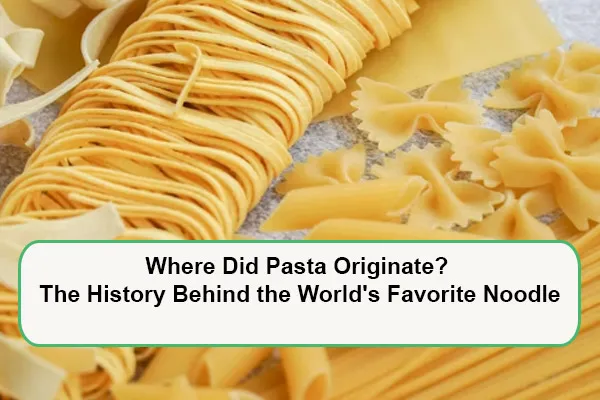
- Regional shape specialization: Different Italian regions developed hundreds of distinct pasta shapes over centuries, many tied to specific sauces, cooking methods, or local ingredients, a level of specialization not replicated elsewhere.
- Industrialization of dried pasta: By the 19th century, particularly around Naples, mechanized production techniques allowed dried pasta to be manufactured at scale, transforming it from a regional specialty into a staple food accessible to much broader segments of the population.
One of the most common points of confusion for diners is treating "pasta" as a single category, when fresh and dried pasta actually represent two genuinely different culinary traditions with different regional roots, ingredients, and ideal uses:
| Type |
Typical Ingredients |
Regional Association |
| Fresh pasta |
Soft wheat flour and eggs |
Traditionally associated with Northern Italy (Emilia-Romagna, Piedmont) |
| Dried pasta |
Durum wheat semolina and water, no eggs |
Traditionally associated with Southern Italy (Naples, Sicily, Puglia) |
Neither style is more "authentic" than the other; they reflect genuinely different regional agricultural histories and culinary priorities within Italy itself.
Pasta's widespread popularity in the U.S. is directly tied to large-scale Italian immigration, particularly from the late 19th century through the early 20th century, when millions of Italians, many from southern regions where dried pasta was already a staple, settled across American cities. Italian immigrant communities established restaurants, groceries, and pasta-making businesses that gradually introduced pasta to the broader American public well beyond Italian American neighborhoods.
Over the following decades, pasta shifted from an immigrant community staple to a mainstream American pantry item, and eventually into a full culinary category unto itself, supporting everything from casual family-style Italian American restaurants to high-end, chef-driven pasta-focused fine dining.
Because pasta appears on so many menus, quality and technique vary enormously. A few markers tend to separate restaurants treating pasta as a genuine craft from those relying on shortcuts:
- House-made pasta, not store-bought. Restaurants producing their own fresh or dried pasta in-house typically offer noticeably better texture and flavor than those using mass-produced, pre-packaged pasta.
- Correct pasta shape for the sauce. Serious kitchens match specific pasta shapes to specific sauces based on established regional pairing logic, rather than treating shapes as interchangeable.
- Proper doneness. Pasta cooked al dente, with a slight firmness at the center, is broadly considered the technical standard; overcooked, mushy pasta is a common sign of inattentive execution.
- Balanced sauce-to-pasta ratio. Well-executed pasta dishes coat the noodles evenly without drowning them in excess sauce, allowing the pasta's own texture and flavor to remain part of the dish.
- Regional specificity. Strong Italian kitchens are often explicit about which regional tradition a given dish draws from, rather than presenting a generalized, undefined "Italian" pasta dish.
These are useful markers for diners evaluating pasta quality, and they're the kind of detail that separates a surface-level restaurant listing from one that actually helps guests understand what they're ordering.
Serious pasta craftsmanship has earned recognition well beyond a handful of major coastal Italian dining hubs:
- Boulder, Colorado: A restaurant focused on the cuisine of Italy's Friuli-Venezia Giulia region has earned both a Michelin star and a James Beard Award for Outstanding Restaurant, built on precise technique paired with local, seasonal ingredients.
- Minneapolis, Minnesota: A James Beard Award-winning chef runs a pasta-focused restaurant built around an open kitchen and pasta bar, where diners can watch fresh pasta made in real time.
- Chicago, Illinois: A "Top Chef" alum's Italian restaurant blends traditional technique with the chef's own heritage, building a strong national reputation around fresh, handmade pasta.
This spread reflects how thoroughly serious, chef-driven pasta cooking has moved beyond big-city Italian American strongholds into a nationally distributed culinary category.
- "Marco Polo brought pasta to Italy from China." Most food historians reject this popular story; documented evidence shows pasta-like foods existing in Italy before his travels.
- "Pasta is a purely Italian invention with no outside influence." Arab trade influence, particularly through Sicily, likely played a meaningful role in dried pasta's early development in Italy.
- "All pasta is basically the same." Fresh, egg-based pasta and dried, semolina-based pasta represent genuinely different regional traditions with different textures, uses, and origins within Italy itself.
- "Authentic pasta always contains eggs." Traditional dried pasta from Southern Italy contains no eggs at all, relying instead on durum wheat semolina and water.
A few trends are likely to keep shaping how pasta appears at American restaurants:
- Continued growth of pasta-focused fine dining. More chef-driven restaurants are building entire concepts around house-made pasta, rather than treating it as one course within a broader Italian menu.
- Renewed regional specificity. As diners become more educated about Italy's regional culinary diversity, expect more restaurants to clearly identify which regional tradition their pasta dishes draw from.
- Alternative grain and dietary experimentation. Expect continued growth in gluten-free, whole grain, and alternative flour pasta options, alongside traditional durum wheat and egg-based versions.
- Greater transparency around technique. As appreciation for handmade pasta grows, expect more restaurants to highlight house production and shape-sauce pairing logic directly on their menus.
Frequently asked questions
No. This is one of the most persistent food history myths, but most food historians reject it, since documented evidence shows pasta-like foods existing in Italy before Marco Polo's travels to Asia.
Pasta's true origin is genuinely debated and likely multi-sourced, involving ancient Mediterranean food traditions, Arab trade influence introduced through Sicily around the 9th century, and independent regional development across the Italian peninsula.
Fresh pasta is typically made with soft wheat flour and eggs, traditionally associated with Northern Italy. Dried pasta is made from durum wheat semolina and water without eggs, traditionally associated with Southern Italy.
Different Italian regions developed distinct pasta shapes over centuries, often tied to specific local sauces, ingredients, or cooking methods, resulting in the extensive shape variety seen today.
Pasta's widespread popularity in the U.S. is closely tied to large-scale Italian immigration between the late 19th and early 20th centuries, which gradually introduced pasta to the broader American public.
Look for house-made pasta, correct shape-to-sauce pairing, proper al dente doneness, a balanced sauce-to-pasta ratio, and a kitchen that's clear about which regional Italian tradition it's drawing from.
Reviewed and verified by the Restaurant Listings Editorial Team for accuracy and relevance. Our content is researched using official restaurant sources, public records, government agencies, and recognized food safety and hospitality industry resources.
Last reviewed: August 2026
Related articles

 Food History & Origins
 Food History & Origins
 Food History & Origins