Pull up the same restaurant on four different apps and you'll often see four different numbers: a 4.6 on Google, a 3.5 on Yelp, a 4.2 on TripAdvisor, and a 4.8 on OpenTable, all describing the exact same kitchen, the exact same menu, the exact same building. This isn't a glitch. Each platform is running its own, genuinely different math behind that star rating, and understanding the differences changes how much weight you should actually put on any single number.
At the most fundamental level, restaurant review platforms fall into two broad categories:
- Simple average systems: The displayed rating is essentially the mean of every star rating ever submitted, with little to no filtering or weighting applied.
- Weighted or filtered systems: The displayed rating starts from an average but is then adjusted based on factors like reviewer credibility, review recency, or detected suspicious activity, meaning the final number diners see isn't a raw average at all.
Google's public rating is generally closer to the first category: a straightforward average of all submitted star ratings, without heavy weighting by recency or reviewer trust applied to the visible number. This helps explain a pattern researchers and reputation-management professionals have both noted: Google ratings tend to skew higher than other platforms, in part because a large volume of casual, quick five-star ratings from occasional reviewers can outweigh more detailed, critical reviews from repeat diners.
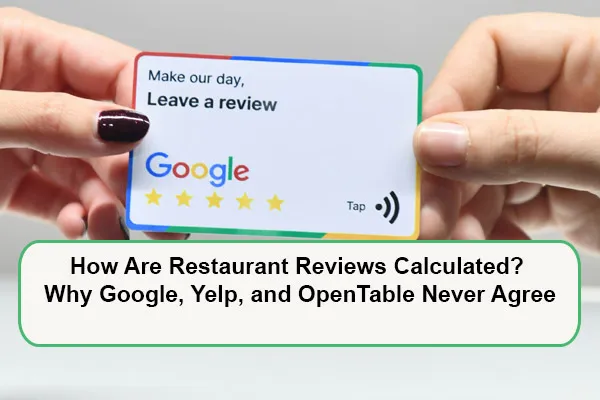
Google's star rating is fundamentally a mean of all star ratings submitted to a business's profile. That said, a few additional factors can influence what a diner ultimately sees:
- Reviews from across the web: Google's Business Profile can display a separate "Reviews from the web" section pulling in ratings from other platforms like Yelp or TripAdvisor, distinct from Google's own native review average.
- Spam and policy filtering: Google does apply filtering to remove reviews that violate its content policies, though this differs from actively weighting legitimate reviews by recency or reviewer history in the core star average.
- Response rate and activity signals: While these don't change the star number itself, Google's broader local search algorithm gives real weight to how frequently a business responds to reviews and posts updates, which can affect visibility even when the star rating stays the same.
Because Google reviews appear directly in Maps and search results, and roughly half of diners check Google first when researching a restaurant, this single number carries an outsized influence on which restaurants even get considered in the first place.
Yelp takes a more actively curated approach than Google's straightforward average. Its recommendation software actively evaluates reviews for authenticity and quality signals, filtering out reviews it determines to be less reliable, which is part of why a restaurant's Yelp rating often runs noticeably lower or differs meaningfully from its Google rating even with a similar underlying customer experience. Yelp has also confirmed that a restaurant's response rate to reviews functions as a positive ranking signal, meaning restaurants that consistently respond tend to perform better in Yelp's search visibility, separate from the star average itself.
Review velocity, meaning how steadily a restaurant accumulates new reviews over time, also factors meaningfully into how both Yelp and Google's underlying algorithms treat a business, beyond just the visible star number. A restaurant that earns reviews steadily over many months tends to perform better algorithmically than one with a small, stagnant review count, even if both show a similar average rating.
Reservation platforms like OpenTable and Resy operate on a fundamentally different model than open platforms like Google or Yelp. Reviews on these platforms are generally limited to diners who actually booked and dined through the platform itself, rather than being open to anyone who wants to leave a rating. This verified-booking requirement is a meaningful structural difference, and it's part of why some analysts treat OpenTable ratings as carrying more built-in reliability per review compared to fully open platforms where anyone can post a rating regardless of whether they ever visited.
These reviews also appear directly within the booking flow itself, meaning they influence a diner's decision at the exact moment they're deciding whether to complete a reservation, a more targeted placement than a general search result rating.
A few structural reasons explain why cross-platform disagreement is the norm rather than the exception:
| Factor |
Why It Creates Differences |
| Reviewer population |
Each platform attracts a different mix of casual versus highly engaged reviewers |
| Verification requirements |
Some platforms require a booking or purchase; others allow open, unverified reviews |
| Filtering methodology |
Some platforms actively filter suspicious or low-quality reviews; others largely don't |
| Sample size |
A rating built from a handful of reviews behaves very differently than one built from thousands |
| Recency weighting |
Some systems weight recent reviews more heavily; others treat a five-year-old review the same as one from last week |
This is also why some third-party tools have started building composite ratings that blend multiple platforms together, explicitly accounting for factors like source reliability, sample size, and recency, rather than treating any single platform's number as the definitive answer.
A 4.8 rating built from 15 total reviews and a 4.3 rating built from 1,500 reviews are not equally trustworthy signals, even though the second number looks lower at a glance. A small number of reviews is far more vulnerable to being skewed by a handful of unusually positive or negative experiences, while a large review volume tends to average out toward a more statistically stable reflection of typical quality. This is a genuinely useful habit for diners to build: checking review count alongside the star number, not just the number by itself.
A few practical factors tend to have an outsized effect on how a restaurant's visible rating evolves:
- How often the restaurant asks for reviews. Restaurants that only capture reviews from a small fraction of diners tend to see slower-growing, sometimes more volatile ratings than those with a consistent, systemic approach to requesting feedback.
- Timing of the request. Reviews requested shortly after a strong dining experience tend to convert at a meaningfully higher rate than delayed or generic requests.
- Response behavior. On platforms like Yelp and Google, consistently responding to reviews, including negative ones, is treated as a positive signal that can influence both visibility and, over time, review sentiment, since a meaningful share of negative reviews get revised after a thoughtful public response.
- Review authenticity policies. Every major platform prohibits incentivizing reviews with discounts or free items, and restaurants that violate these policies risk review removal or reduced visibility, which can create sudden, noticeable rating shifts unrelated to actual food or service quality.
Given how differently each platform calculates its number, a few habits make ratings meaningfully more useful:
- Check review count, not just star average, since a rating built from a small sample size is far less reliable than one built from a large, sustained volume of reviews.
- Look at more than one platform when possible, since Google, Yelp, and reservation-based platforms each reflect a somewhat different reviewer population and methodology.
- Read a handful of actual written reviews, not just the number, since sentiment and specific detail often reveal more than an aggregate score alone.
- Pay attention to recency, since a restaurant that was excellent two years ago may have changed meaningfully since then, particularly after a change in chef, ownership, or management.
- "All platforms calculate ratings the same way." They don't. Some use a straightforward average, while others apply filtering, weighting, or verification requirements that meaningfully change the resulting number.
- "A higher star number always means a better restaurant." Not necessarily, particularly when comparing a high rating built from very few reviews against a slightly lower rating built from a much larger, more stable sample.
- "Ratings should always match across platforms." Disagreement between platforms is the norm, not a sign that something is broken, because each platform is genuinely measuring a somewhat different population and applying different methodology.
- "Old reviews and new reviews should count the same." Some platforms and third-party tools explicitly weight recent reviews more heavily, recognizing that restaurant quality can change significantly over time.
A few trends are likely to keep shaping how restaurant ratings work and how diners use them:
- Growth of composite, cross-platform ratings. Expect more tools to blend multiple platforms into a single, weighted score rather than relying on any one source alone.
- Increased use of AI-driven search summarization. AI search tools increasingly pull directly from review content when answering questions like "best restaurants near me," extending review influence beyond the platforms where reviews are originally posted.
- Greater emphasis on verified, booking-based reviews, as reservation platforms continue building review systems tied specifically to confirmed dining visits rather than open, unverified submissions.
- Continued scrutiny of review authenticity, as platforms keep refining how they detect and filter incentivized, fake, or otherwise unreliable reviews.
Frequently asked questions
Because the two platforms calculate ratings differently. Google's rating is closer to a straightforward average of submitted reviews, while Yelp actively filters and evaluates reviews for reliability, often producing a different resulting number even for the same restaurant.
Not necessarily. A 4.8 built from a small number of reviews is statistically less reliable than a 4.3 built from a much larger review volume, since small samples are more easily skewed by a handful of outlier experiences.
They tend to carry a built-in verification advantage, since reviews are generally limited to diners who actually booked and dined through the platform, unlike fully open platforms where anyone can leave a review regardless of whether they visited.
It can influence visibility and sentiment over time. Platforms like Yelp treat response rate as a positive ranking signal, and a meaningful share of negative reviews get revised after a thoughtful public response from the business.
Because a rating built from very few reviews can be heavily skewed by a small number of unusually positive or negative experiences, while a larger review volume tends to reflect a more statistically stable, reliable picture of typical quality.
Yes. Major review platforms prohibit incentivizing reviews with discounts, free items, or contest entries, and restaurants that violate these policies risk having reviews removed or their visibility reduced.
Reviewed and verified by the Restaurant Listings Editorial Team for accuracy and relevance. Our content is researched using official restaurant sources, public records, government agencies, and recognized food safety and hospitality industry resources.
Last reviewed: August 2026
Related articles

 Restaurant Awards