
 Food History & Origins
Chicago Tavern-Style Pizza: Neighborhood Traditions and Wher...
Published On 15-10-2026
Published by Restaurant Listings Editorial Team
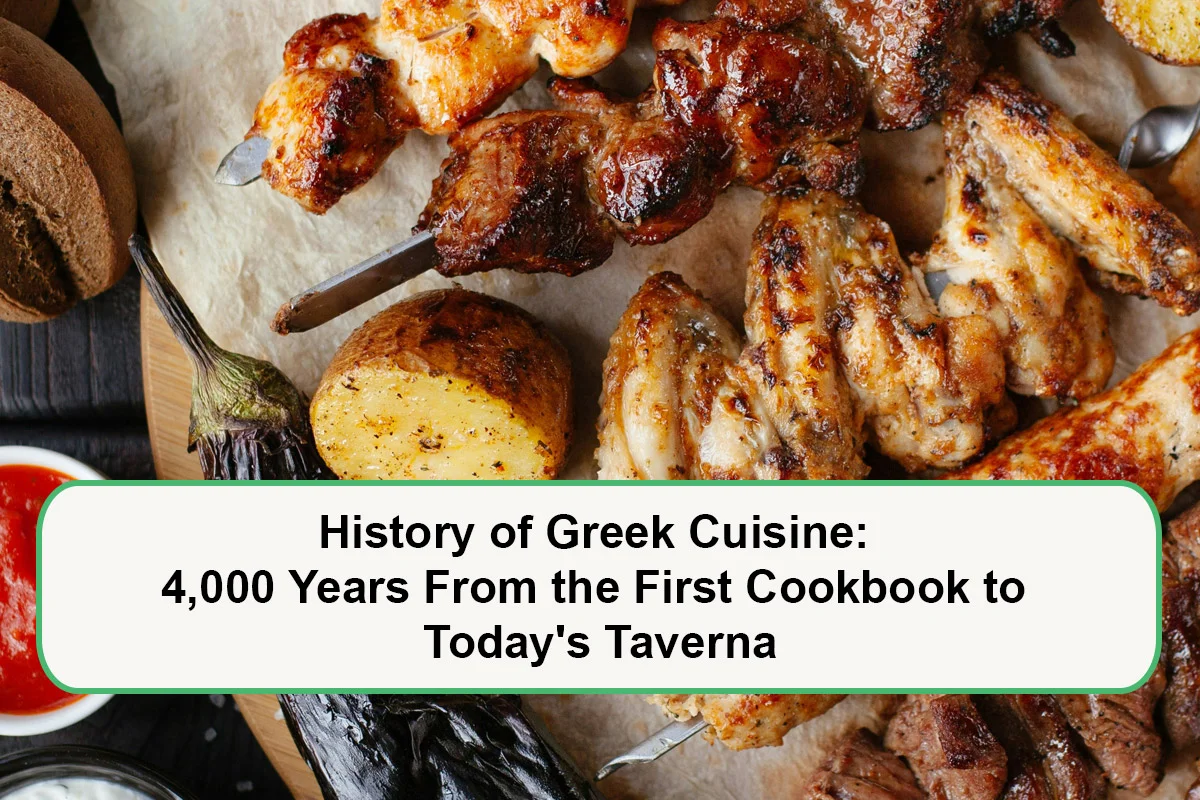
Greek cuisine carries one of the longest continuous culinary histories in the world, stretching back roughly 4,000 years and including what's widely considered the first cookbook ever written. But the moussaka, souvlaki, and baklava most people associate with Greek food today are layered with centuries of outside influence, Roman, Byzantine, and especially Ottoman, that most diners never realize is baked directly into the cuisine's most iconic dishes.
Greek culinary history's earliest roots trace back to the Minoan civilization around 2700 BCE, who domesticated grains and pressed some of the first olive oil in the region, an ingredient that would go on to become foundational not just to Greek cooking but to the Greek economy itself. Ancient Greek cuisine was built around what's commonly called the Mediterranean triad: wheat, olive oil, and wine, a simple, frugal foundation that remained central to Greek eating for centuries.
Meat was relatively rare in the ancient Greek diet, generally reserved for religious festivals and sacrifices, while fish was considerably more common, unsurprising given that no part of mainland Greece sits more than about 90 miles from the sea. Bread, olives, cheese, honey, legumes, and fruits like figs and grapes rounded out the everyday diet, and food itself carried genuine religious weight: ancient Greeks viewed the preparation and sharing of food as a way of connecting mortals with the divine, not merely as sustenance.
One of the most remarkable facts in all of culinary history: the ancient Greek poet Archestratos wrote what's widely considered the first cookbook ever recorded, around 320 BCE. This wasn't a footnote; it represents the earliest known instance of food writing as a distinct, standalone genre, positioning Greek cuisine as an early forerunner not just of Western cooking broadly, but of culinary documentation itself.
Greek cuisine's influence spread further as Alexander the Great extended Greek territory from Europe into India in 334 BCE, and later, as Roman conquest of Greece in 146 BCE created a genuine two-way culinary exchange, with Greek culinary influence flowing into Roman cooking even as Greece absorbed elements of Roman cuisine in return. This early pattern, absorbing outside influence while simultaneously exporting Greek culinary ideas outward, would repeat itself again and again over the following two millennia.
In 330 CE, Emperor Constantine founded the Byzantine Empire on the site of the former Greek colony of Byzantium, ushering in a period that left its own distinct mark on Greek cooking. Byzantine cuisine introduced richer, more elaborate sauces built from combinations of olive oil, wine, vinegar, herbs, and spices, a meaningful step up in complexity from the simpler ancient Greek diet. Byzantine bakers are also specifically credited with perfecting pastry-making technique, giving rise to phyllo-based dishes like baklava and bougatsa that remain closely associated with Greek cuisine today. Bread held enormous importance in the Byzantine diet as well, commonly eaten alongside olives and cheese as a primary meal rather than simply a side item.
If any single historical period reshaped Greek cuisine most dramatically, it's the roughly four centuries of Ottoman rule over Greece, spanning from the 15th to the 19th century. This wasn't a minor culinary footnote; many food historians consider it the single most transformative period in Greek cuisine's post-ancient history, on par with how Moorish rule reshaped Spanish and Portuguese cooking.
The Ottomans introduced yogurt, lamb, and an extensive array of new spices, along with slow-cooking techniques, stews simmered for hours to intensify flavor, and meats roasted on spits over open fire. Aromatic additions like cinnamon, cloves, allspice, mint, oregano, and dill all became embedded in Greek cooking during this period.
Perhaps most tellingly, during Ottoman rule, many Greek dishes were required to be referred to by their Turkish names, and remarkably, many of those names have persisted into modern Greek cuisine. Moussaka, baklava, and keftedes all carry names with direct Turkish, Persian, or Arabic roots, a linguistic fingerprint of centuries of Ottoman rule still sitting in plain sight on Greek menus today. Meze, the beloved Greek tradition of shared small plates, similarly traces its name back through Ottoman-era cuisine to the Persian word "maze," meaning to taste or snack, even though the underlying tradition of small shared bites has roots stretching back to ancient Greek civilization itself.
Similar to the pattern seen in Spanish and Italian cuisine, several ingredients now considered inseparable from Greek cooking arrived only after European contact with the Americas. Potatoes, tomatoes, spinach, and other New World crops weren't incorporated into Greek cuisine until after the discovery of the Americas, meaning tomato-based Greek dishes, now among the most recognizable in the cuisine, represent a relatively recent addition layered on top of a much older ancient and Byzantine foundation.
A handful of Greece's most famous dishes each carry a genuinely layered, multi-era origin story worth knowing:
| Dish | Layered Origin |
|---|---|
| Moussaka | Eggplant and meat layering reflects Middle Eastern culinary influence, particularly shaped and popularized during the Ottoman period |
| Souvlaki | Grilled meat skewers date back to ancient Greece, with references appearing as far back as Homer's Iliad |
| Spanakopita | Spinach and feta phyllo pastry traces to Byzantine-era pastry-making tradition |
| Baklava | Though widely associated with Turkish and broader Middle Eastern cuisine today, variations existed within Greek culinary history as well, reflecting genuinely shared regional heritage rather than a single clean origin |
This layering is exactly why arguments over which country "really" invented a given dish, baklava especially, tend to miss the point. Centuries of shared regional history, spanning Ottoman, Byzantine, Persian, and Greek culinary tradition simultaneously, make many of these dishes genuinely collective rather than the exclusive invention of any single culture.
Despite all this layered outside influence, a few core characteristics have remained remarkably consistent across every era of Greek culinary history:
Greek food's presence in the U.S. grew substantially through 20th-century Greek immigration, with Greek American communities establishing diners, tavernas, and restaurants across the country that introduced dishes like gyros, souvlaki, and spanakopita to a broad American audience well before "Mediterranean cuisine" became a widely recognized culinary category. More recently, the Mediterranean diet's association with health and longevity has driven renewed, broader American interest in Greek cooking specifically, reinforcing its reputation as both a historic and a genuinely health-conscious cuisine.
A few trends are likely to keep shaping how Greek food appears on American menus:
Reviewed and verified by the Restaurant Listings Editorial Team for accuracy and relevance. Our content is researched using official restaurant sources, public records, government agencies, and recognized food safety and hospitality industry resources.
Last reviewed: August 2026
Food History & Origins
 Food History & Origins
 Food History & Origins