
 Food History & Origins
Chicago Tavern-Style Pizza: Neighborhood Traditions and Wher...
Published On 15-10-2026
Published by Restaurant Listings Editorial Team
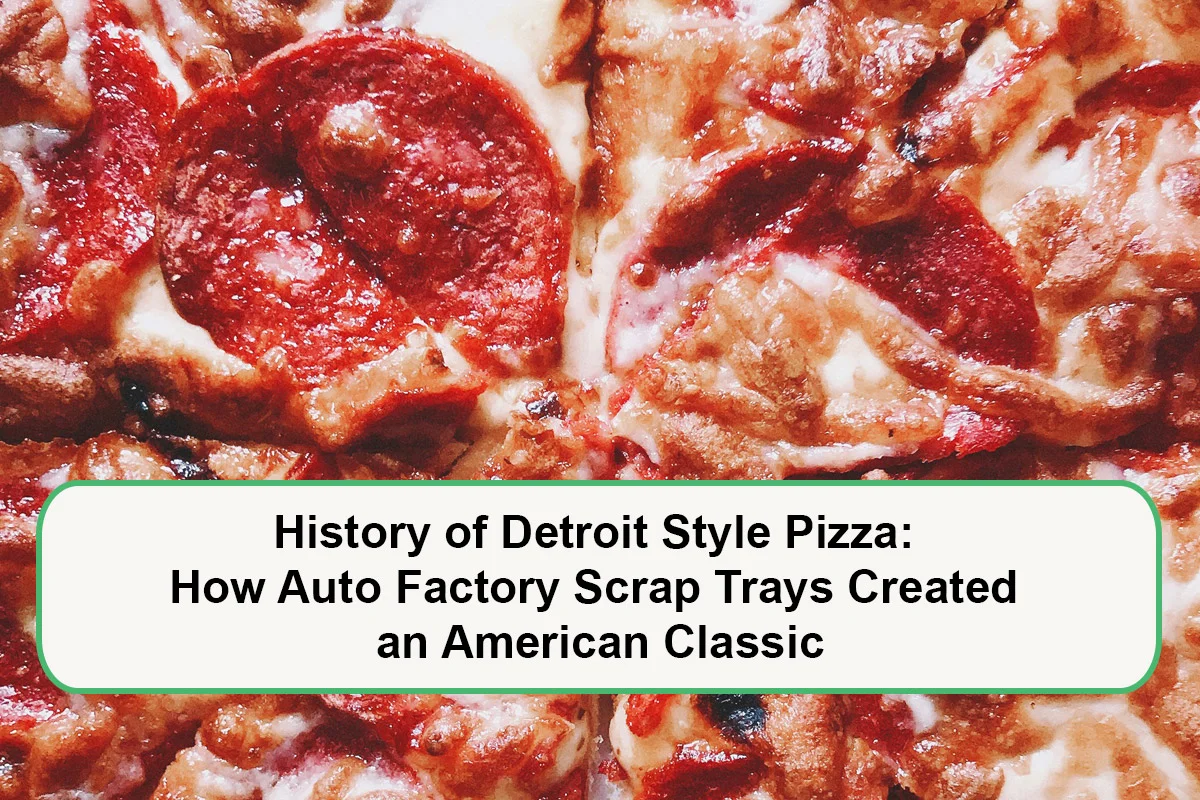
Detroit style pizza is defined by a piece of equipment that has nothing to do with cooking at all: a rectangular blue steel tray originally built to catch drips and hold small parts on an automotive assembly line. That single, practical borrowing from Detroit's manufacturing economy is the entire reason this pizza style looks and tastes the way it does, and the dish itself went largely unnamed in its own hometown for decades.
Detroit style pizza traces back to Buddy's Rendezvous, a bar that opened in 1936 on Six Mile and Conant Street on Detroit's east side, originally operating as a speakeasy. Ten years later, in 1946, owner Gus Guerra decided the bar needed food on the menu and turned to his Sicilian mother in law for guidance, landing on a thick, square pizza based on sfincione, a traditional Sicilian style bread. Some historical accounts credit the specific recipe to Guerra's wife Anna's family tradition, while others point to a longtime employee, a Sicilian woman named Connie Piccinato, as the person who actually refined the dough. As with many regional American dish origin stories, the exact division of credit between family members and kitchen staff isn't fully settled, though everyone agrees the dish itself debuted at Buddy's in 1946.
The defining detail of Detroit style pizza isn't an ingredient, it's the pan. Guerra baked his first square pizzas in blue steel trays that had originally been manufactured for entirely different purposes: catching drips or holding small automotive parts on the line at local factories, sourced during Detroit's Golden Age of Automotive Design, a period running roughly from 1946 to 1973. According to Guerra's own son, Jack Guerra Sr., his father never fully explained exactly where he located that first batch of pans, only that they'd previously served as auto parts trays. The thick blue steel functions much like a well seasoned cast iron skillet, retaining heat intensely and building flavor into the crust over repeated use, which is exactly what gives Detroit style pizza its signature light, crispy, almost fried texture along the edges.
Detroit style pizza inverts the layering order most people expect from a pizza. Pepperoni or other toppings go directly onto the dough first, allowing their flavor to be absorbed straight into the crust as it bakes. Wisconsin brick cheese, a proprietary blend developed specifically for the style, is spread edge to edge across the entire pan, deliberately touching the pan's sides so it caramelizes into a crisp, lacy, slightly burnt border, widely considered the single most prized part of the pizza by dedicated fans. Only after that does the sauce go on top, typically applied in two or three distinct stripes rather than spread evenly, a presentation detail that's become as recognizable as the pizza's shape itself.
Here's a detail that surprises even longtime Detroit pizza fans: the term "Detroit style pizza" barely existed in the city itself for much of the dish's history. Wesley Pikula, Buddy's chief brand officer, who started working there as a busboy in the 1980s, has said he never heard the term "Detroit style" before that decade, when it first appeared in a trade magazine, and even then it remained rare outside national trade publications. As late as 2007, local Detroit media outlets were still referring to the dish simply as "Sicilian style" pizza, reflecting its actual culinary lineage rather than the geographic brand name that eventually stuck nationally. The pizza existed as a beloved local specialty for over sixty years before it had the name most people now use for it.
Detroit locals have long ordered this pizza as a "square," even though the pans, and the pizzas that come out of them, are actually rectangular rather than square. This is simply longstanding local slang rather than a technical description, one of several small details that mark out a true Detroit native from someone encountering the style for the first time.
Buddy's changed hands more than once over the following decades. Gus Guerra sold the original Buddy's Rendezvous in 1953 and went on to open the Cloverleaf Bar in nearby Eastpointe, Michigan, continuing to serve his square pizza there under a new name. The original Buddy's location was later purchased around 1972 by William "Billy" Jacobs, reportedly because his wife enjoyed the pizza, and his son Robert Jacobs expanded the business significantly before selling to a private equity group in 2019. Meanwhile, former Buddy's employee Louis Tourtois struck out on his own to found Loui's Pizza in Hazel Park, Michigan, directly explaining why Loui's pizza tastes so similar to Buddy's original recipe. Other locally notable chains, including Jet's and Shield's, extended the style even further across metro Detroit.
Detroit style pizza is frequently confused with Chicago deep dish, since both are baked in deep, non-round pans, but the two styles are genuinely distinct in both technique and texture:
| Feature | Detroit Style | Chicago Deep Dish |
|---|---|---|
| Shape | Rectangular | Round |
| Crust texture | Light, airy, with a crispy fried bottom and caramelized cheese edge | Thick, dense, more biscuit like |
| Cheese placement | Spread edge to edge, touching the pan for caramelization | Layered beneath the sauce, not touching the pan edges |
| Sauce placement | Applied on top in stripes after baking | Spread as a thick layer beneath toppings before baking |
For most of its history, Detroit style pizza remained a genuinely local specialty, known mainly to Michigan residents and the occasional curious traveler. That began changing substantially over roughly the past decade, and much of the credit goes to Detroit's broader civic and tourism revival. As more visitors and travelers began experiencing the city firsthand, many encountered Buddy's and similar pizzerias for the first time and helped spread word of the style well beyond Michigan, contributing directly to Detroit style pizza's emergence as one of the most talked about regional pizza styles in the country over the last several years.
A few trends are likely to keep shaping the style's next chapter:
Reviewed and verified by the Restaurant Listings Editorial Team for accuracy and relevance. Our content is researched using official restaurant sources, public records, government agencies, and recognized food safety and hospitality industry resources.
Last reviewed: September 2026
Food History & Origins
 Food History & Origins
 Food History & Origins