
 Food History & Origins
Chicago Tavern-Style Pizza: Neighborhood Traditions and Wher...
Published On 15-10-2026
Published by Restaurant Listings Editorial Team
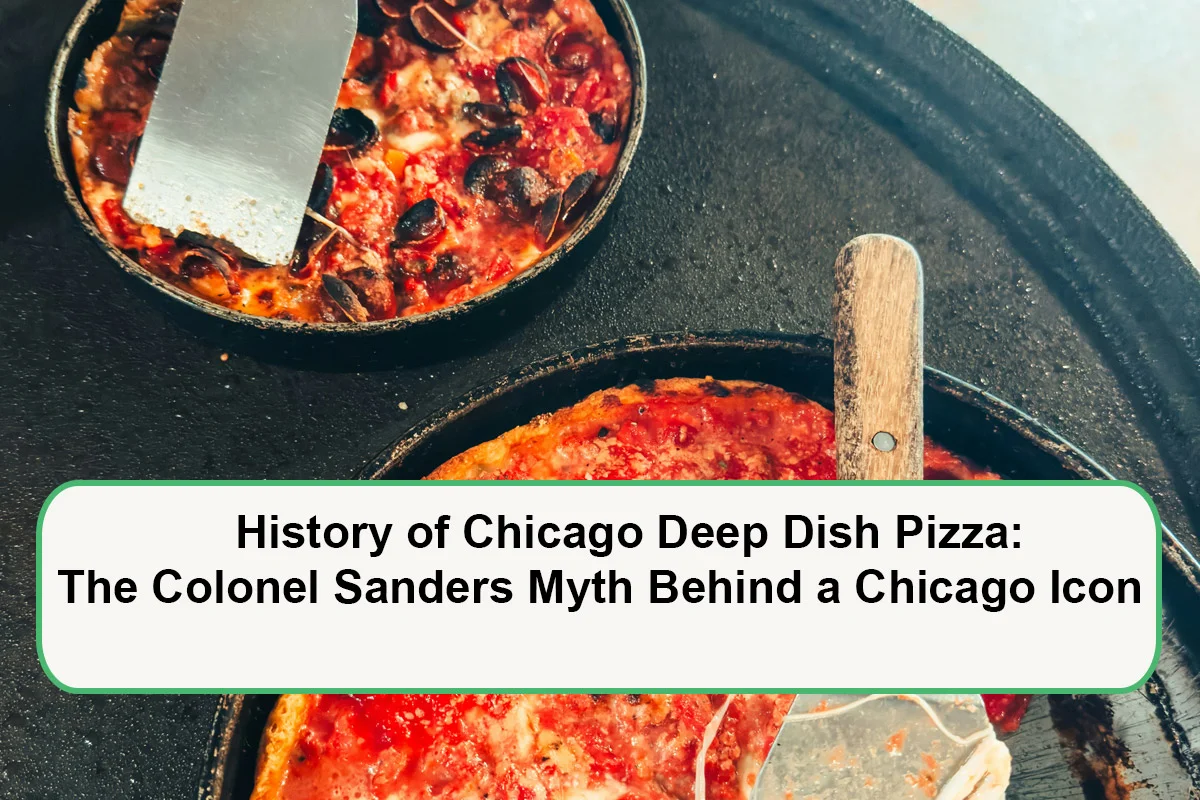
Chicago deep dish pizza has an origin story that most people know in its simplified, corporate-approved version: a college football star named Ike Sewell invented it in 1943 and built an empire on it. The real history, pieced together by historians digging through primary sources, newspaper archives, and family testimony, is considerably messier, and it reveals that the man most closely associated with inventing deep dish almost certainly didn't create the recipe at all.
The undisputed birthplace of Chicago deep dish is a 19th-century mansion at 29 East Ohio Street, where a restaurant simply called "The Pizzeria" opened in December 1943. The two names most associated with founding it are Ike Sewell, a Texas-born former college football star who'd moved to Chicago in 1934 to work as a liquor company sales manager, and Ric Riccardo, an Italian-American artist and restaurateur who'd already built a following with a popular spot on Rush Street. As the popular version of the story goes, Sewell originally wanted to open a Mexican restaurant, and Riccardo talked him into Italian food instead, specifically a heartier, more substantial pizza than the thin Neapolitan style most Americans hadn't even encountered yet.
Here's where the popularly repeated story starts to break down under scrutiny. According to research from the Culinary Historians of Chicago, primary source records suggest Sewell likely had no direct or indirect ownership stake in The Pizzeria when it opened in December 1943 at all. He only became a part-owner afterward, and even then indirectly, since it was his wife Florence who signed the 1944 partnership agreement, not Sewell himself. If that timeline holds up, it means the man most commonly credited as deep dish's inventor may not have even had a formal stake in the restaurant during the period when the dish was supposedly being created.
Primary source research points toward Riccardo as the person who actually deserves the most credit, based on more than just word of mouth. Records show Riccardo lived with his family in an apartment at 29 East Ohio Street from late 1942 until 1944, meaning he was physically living above the pizzeria during its formative period, not simply dropping by as an investor. A 1954 Chicago Sun-Times article backs this up, describing the restaurant's recipe as having been "created during a year of experimentation," a detail that lines up closely with Riccardo's residency there. Sewell himself gave Riccardo direct credit in a 1977 Chicago magazine interview, saying plainly: "It wasn't that I believed in deep dish pizza. It was that I believed in Ric Riccardo... once he began trying to develop deep-dish pizza, he stayed home."
The other major name tied to deep dish's invention is Adolpho "Rudy" Malnati Sr., whose sons Lou and Rudy Jr. went on to found two of Chicago's most famous rival deep dish chains, Lou Malnati's and Pizano's. The Malnati family has long maintained that Rudy Sr. created the original recipe, pointing to a 1956 Chicago Daily News article that credits him with helping establish Pizzeria Uno. The problem with this claim is timing: research published in Chicago magazine found that Malnati was actually the pizzeria's third manager, starting in February 1951, roughly eight years after the restaurant first opened and the dish was supposedly invented. Before that, he'd worked as a bartender at Riccardo's earlier restaurant, meaning his documented involvement with The Pizzeria itself doesn't overlap with its founding period at all.
One name frequently left out of the popular version of this story is Alice May Redmond, a kitchen employee at the original pizzeria with a background in Southern cooking. Some historians have suggested she may have applied that background to help develop the thicker-than-average crust that came to define the dish, and after leaving Pizzeria Uno, she went on to help found Gino's East, one of the city's other major deep dish institutions. Her role tends to get less attention than Sewell's or the Malnati family's, largely because, like Riccardo, she had no financial incentive tied to promoting a founder narrative decades later.
Perhaps the most genuinely surprising discovery in recent deep dish research involves the crust itself. In 2013, a Chicago magazine writer uncovered what's believed to be the original deep dish dough recipe, unpublished since 1945, and it describes something dramatically different from the thick, heavy, biscuit-like crust served at deep dish restaurants today. The original recipe reportedly produced a thinner, lighter, almost cake-like golden-brown crust, a texture that would surprise most modern deep dish fans expecting the dense, substantial base associated with the dish now. This means even the foundational element of Chicago deep dish evolved significantly after its earliest years, further complicating any single, tidy story of exactly how the dish was "invented."
The clean, single-inventor version of this story, Ike Sewell as the sole genius behind deep dish, has a fairly clear and documented origin of its own: corporate marketing. After Riccardo's death in 1954, Sewell became sole owner and eventually renamed the restaurant Pizzeria Uno. In 1977, he sold the business to a Boston-based conglomerate, and according to historian Peter Regas, the new company's CEO explicitly framed Sewell as a folk-hero founder figure, reportedly telling Regas, "Ike Sewell is our Colonel Sanders," a direct comparison to the fully mythologized, simplified founder image built around KFC. That marketing decision is a large part of why Sewell's name became so thoroughly associated with deep dish's invention in popular culture, regardless of what the actual documented record supports.
Whatever the true division of credit, Sewell's promotional instincts genuinely did drive deep dish's spread. Early on, staff reportedly handed out samples to pedestrians and bar patrons around the neighborhood specifically to build interest in the unfamiliar, substantial style of pizza. The strategy worked well enough that Sewell opened a second location a block away in 1955, naming the original Pizzeria Uno and the new one Pizzeria Due. By 1980, Sewell had begun franchising Uno nationally, and the chain eventually expanded internationally, carrying Chicago deep dish far beyond the city that created it. Meanwhile, the rival chains built by the dish's other claimed inventors, Lou Malnati's (1971), Pizano's (1991), and Gino's East, grew into their own deeply rooted Chicago institutions, each carrying a piece of the competing origin story forward.
Regardless of who gets ultimate credit, a few consistent technical elements separate genuine Chicago deep dish from other pizza styles:
A few trends are likely to keep shaping how deep dish is understood and served going forward:
Reviewed and verified by the Restaurant Listings Editorial Team for accuracy and relevance. Our content is researched using official restaurant sources, public records, government agencies, and recognized food safety and hospitality industry resources.
Last reviewed: September 2026
Food History & Origins
 Food History & Origins
 Food History & Origins